
Key points
- Higher temperatures caused European honeybees to slow down their attraction to light, while native Australian bees’ light attraction appeared unaffected.
- Light simulating natural sunlight elicited a similar response in bees compared with simulated artificial city light.
- Bees living in urban and natural environments demonstrated similar light attraction responses.
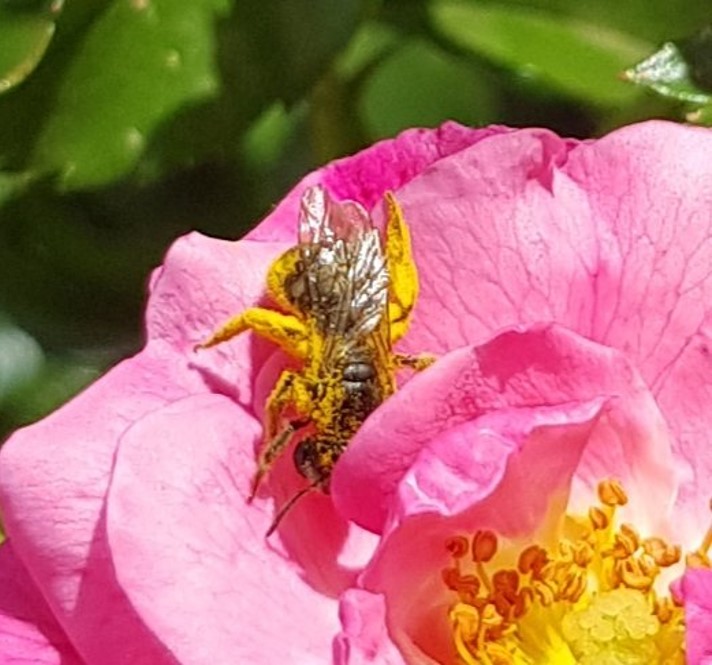
Research from Monash University explores how rising temperature and growing urban environments can affect behaviour in native Australian bees and the European honeybee.
Bees play a vital role in pollinating crops, gardens and native plants, yet global insect populations are under pressure from climate change and habitat loss. To understand how these pressures might influence bee behaviour, researchers compared the responses of native and introduced bees, which resided in urban and natural sites across and outside greater Melbourne.
The study, which was published in the Journal of Insect Physiology, measured phototactic responses (attraction to light) under varying temperatures (28 °C and 32 °C) towards UV light (simulating more ecologically relevant light) and artificial white light (simulating less ecologically relevant light).
The results revealed significant differences in behaviour between native bees and introduced honeybees, with honeybees exhibiting faster responses under all conditions.
Temperature significantly impacted the phototaxis for honeybees, with the higher temperature resulting in slower phototaxis (reduced attraction to light), but no significant effect was observed for native bees. It was found that neither urbanisation nor light type had a significant effect on the response time in either honeybee or native bees.
Dr Scarlett Howard from the School of Biological Sciences, said the findings of this study suggest that temperature changes associated with climate change could alter key behaviours in honeybees, potentially affecting how they forage and navigate.
“The finding that some bees changed their behaviour under the influence of certain stressors, but not others, highlights the complexity of how multiple interacting environmental threats impact pollinators,” said Dr Howard.
“Understanding how bees respond to environmental change is critical because their behaviour underpins pollination, which supports healthy ecosystems and food production. Our results help fill a gap in knowledge about how temperature and urban pressures interact to influence pollinator behaviour.”
Key findings of the research found:
- Native bees and honeybees differ in their phototactic responses, which can also vary with temperature, but not with the urbanisation level from which the bee originates.
- Bees exhibited a generalised phototactic response to both artificial white and narrowband UV light sources.
- Bees may not necessarily respond differently to ecologically relevant or irrelevant lighting types.
The study emphasises the need for continued research into how interacting global changes can affect pollinator species differently, and what this means for conservation and supporting different bee species in agricultural and urban systems.
Read the research paper: https://doi.org/10.1016/j.jinsphys.2025.104927
ASSETS AVAILABLE
Images available here
MEDIA ENQUIRIES
Hande Cater
Media and Communications Manager
P: +61 456 428 906
E: hande.cater@monash.edu
GENERAL MEDIA ENQUIRIES
Monash Media
P: +61 3 9903 4840
E: media@monash.edu
For more experts, news, opinion and analysis, visit Monash News.