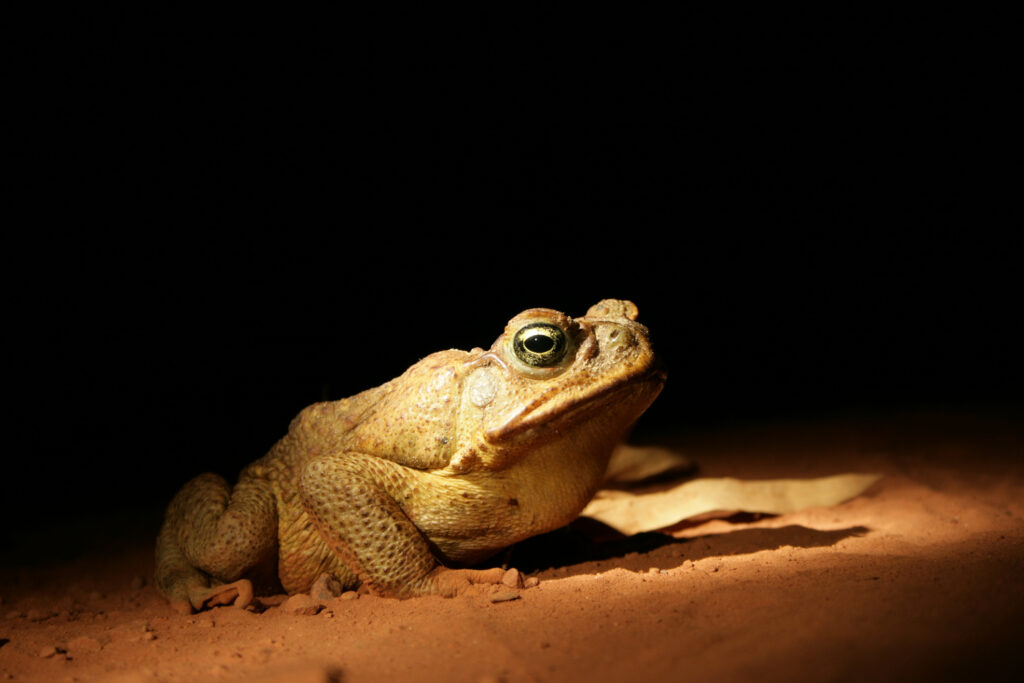

Cane toads are predicted to invade Western Australia’s Pilbara region by 2041 if left unchecked, but the Northern Territory’s population of the pests hold key lessons that could save billions in eradication costs.
In a study led by Curtin University and supported by researchers from other institutions including Charles Darwin University (CDU), academics found the toxic creatures could colonise three quarters of the Pilbara, threatening 25 native species in the biodiversity hotspot.
Co-author Dr Chris Jolly, an adjunct for CDU’s Research Institute for the Environment and Livelihoods (RIEL), said existing toad containment zones in the NT held key insights for any future actions to protect the Pilbara region.
Dr Jolly said the Territory had naturally occurring containment zones using seawater, with coastal locations such as Groote Eylandt and the Tiwi Islands serving as refuges for wildlife like northern quolls.
“The careful monitoring of the impacts of toads, and a deep understanding of their invasion ecology and evolution in Australia has predominantly come from studying cane toads as they moved through the NT,” he said.
“It is what we have learnt from toads in the NT that has provided the crucial information to inform the potential impacts of toads if they were to make it into the Pilbara, as well as understanding how and when they might get there.”
The study showed establishing a containment zone in the naturally dry area where the Great Sandy Desert meets the ocean would hinder the invasive species’ destructive path through WA.
Lead author Dr Judy Dunlop, from Curtin University’s School of Molecular and Life Sciences, said the only available water sources in this area were artificial cattle watering points.
“By upgrading these points – specifically, replacing open dams with concrete tanks and troughs that are inaccessible to toads – we can remove the ‘stepping stones’ toads would use to cross the arid zone,” Dr Dunlop said.
“This targeted intervention could halt their advance into the Pilbara, protecting its unique biodiversity and reducing the risk of catastrophic declines in native species such as northern quolls, ghost bats, goannas, and blue-tongue skinks.”
Dr Dunlop said it was always preferable to prevent an environmental hazard before it occurs.
“In the case of cane toads, our study shows that eradicating them from the vast Pilbara region if they were to become established would be virtually impossible and would cost billions of dollars,” she said.
“By contrast, installing and maintaining a containment zone represents a far more practical and cost-effective solution.
“The investment required for containment is modest compared to the astronomical costs and low feasibility of eradication.”
She said implementing a similar strategy in the Territory’s arid, toad-affected zones could significantly reduce the distribution of cane toads in the NT during the dry season.
Quantifying the potential impact of the cane toad (Rhinella marina) on biodiversity in Australia’s Pilbara region was published in Scientific Reports.
Contact details:
Sierra Haigh she/her
Communications Officer
Marketing, Media & Communications
Larrakia Country
E: sierra.haigh@cdu.edu.au
W: cdu.edu.au

Charles Darwin University acknowledges all First Nations people across the lands on which we live and work, and we pay our respects to Elders both past and present.
CRICOS Provider No. 00300K | RTO Provider No. 0373 | TEQSA Provider ID PRV12069