- Manufacturing and logistics sectors in Australia remain heavily reliant on worker-based safety reporting, with 75% of managers depending on staff alerts for incidents
- Only 34% of managers report having user-friendly modern safety technology, whilst 46% acknowledge possible site entry with incomplete training
- Audit processes are problematic, with 53% reporting excessive manual processes and 63% spending more time on preparation than learning
- Despite 57% of managers trialling AI safety features, adoption is slow due to concerns about job displacement and limitations on AI decision-making
- Research suggests successful safety improvements come from reducing friction and automating enforcement rather than simply adding more tools
Manufacturing and logistics remain among Australia’s most operationally exposed industries, where safety still relies heavily on workers noticing, reporting and responding to risk. New research suggests that without stronger system-level controls, this reliance continues to create preventable gaps.
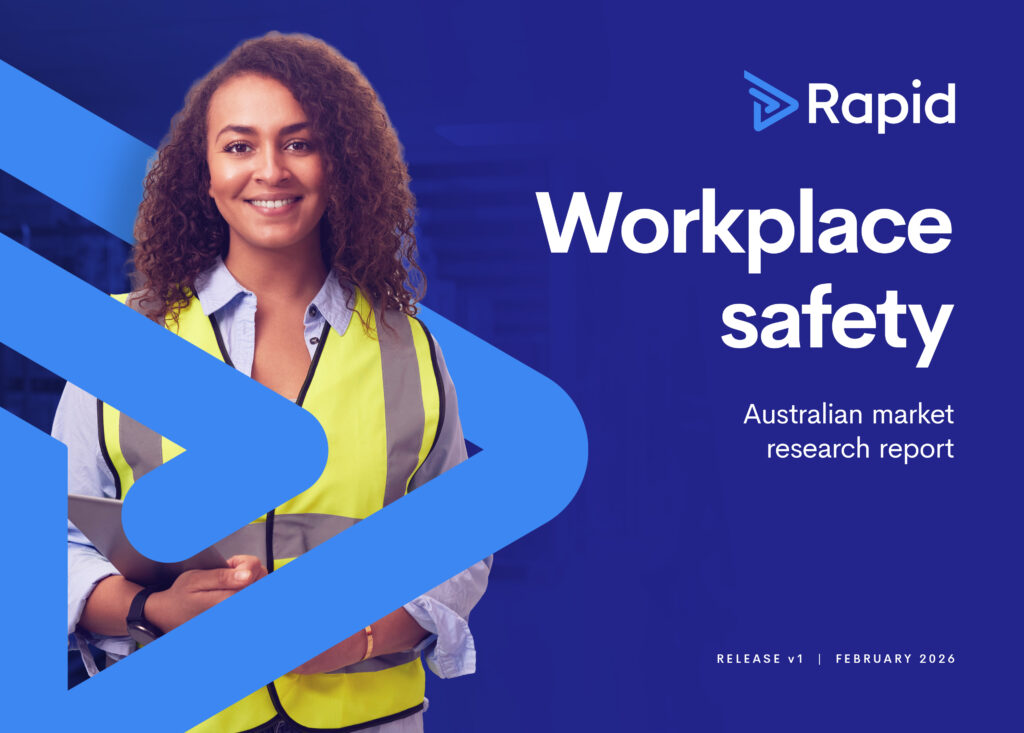
The Australian Workplace Safety Market Research Report, commissioned by Rapid Global and conducted by Research Without Barriers, surveyed more than 1,000 safety managers, workers, and contractors across high-risk industries, including manufacturing and logistics.
Manufacturing and logistics is one of the most operationally exposed sectors in the research. Despite the widespread phase-out of paper-based processes, safety still hinges on workers' awareness, reporting, and compliance, not on systems that automatically prevent issues. 75 per cent of managers say they rely heavily on workers to alert them to incidents, and 46 per cent admit it is possible to enter a site even if training is incomplete or expired. Only 34 per cent of managers say their safety systems feature modern technology that is simple to use.
Audit and reporting processes are a particular pressure point. 53 per cent of managers feel that audits are still too manual or paper-based, and 63 per cent admit that they spend more time preparing for audits than learning from them, with 50 per cent admitting that audits are often rushed or treated as a mere tick-box exercise.
Interest in AI is high, but confidence remains mixed. While 57 per cent of managers are piloting AI features for safety, 48 per cent worry AI could replace their role, and 45 per cent of workers believe AI should be used only for data analysis, not decision-making. The result is experimentation without full adoption, slowing the sector’s ability to reduce manual effort and close safety gaps.
Professor Dr Andrew Sharman, a global authority on safety culture and CEO of the International Institute of Leadership & Safety Culture, says the findings reflect a familiar pattern seen repeatedly across global workplaces. “Safety is often well documented, yet not consistently felt by people on the ground,” he says. “Bridging the gap between policy and practice is less about systems alone and much more about leadership. Trust is the critical differentiator.”
The findings, according to Ezequiel Gonzalez, Head of Revenue at Rapid Global, demonstrate that complexity, rather than intent, increasingly shapes safety risk. "Australia has made significant progress in workplace safety, yet complacency remains," he asserts. "Complex, high-risk environments require more than simply checking boxes. " Technology should not replace human judgement but make it sharper. When systems are easier to use and data is easier to act on, safer outcomes follow.”
According to the research, the organisations most likely to improve safety outcomes are not those modernising with the most tools but those reducing friction, automating enforcement, and making safe behaviour the easiest option for day-to-day reality on site.
For manufacturing and logistics leaders, the opportunity lies in shifting safety from a people-dependent model to a system-enabled one, using AI and automation not to replace judgement, but to reduce administrative burden and close compliance gaps before incidents occur.
To access the report, please visit: https://rapidglobal.com/lp/au-market-research/
About us:
About Rapid Global
Rapid Global is an Australian AI-powered platform transforming workplace safety and compliance, with more than 7m users worldwide. Trusted by leading global companies, Rapid brings together more than 20 years of industry experience to deliver a smarter, more proactive approach to managing safety. From contractor pre-qualification and online inductions to visitor management, site access control, audits, AI-enabled camera monitoring, and incident reporting, Rapid gives organisations one connected platform to keep people safe and workplaces compliant. https://rapidglobal.com/
Contact details:
Louise Nealon, PR With Purpose, louise@prwithpurpose.com.au, 0403 569177