
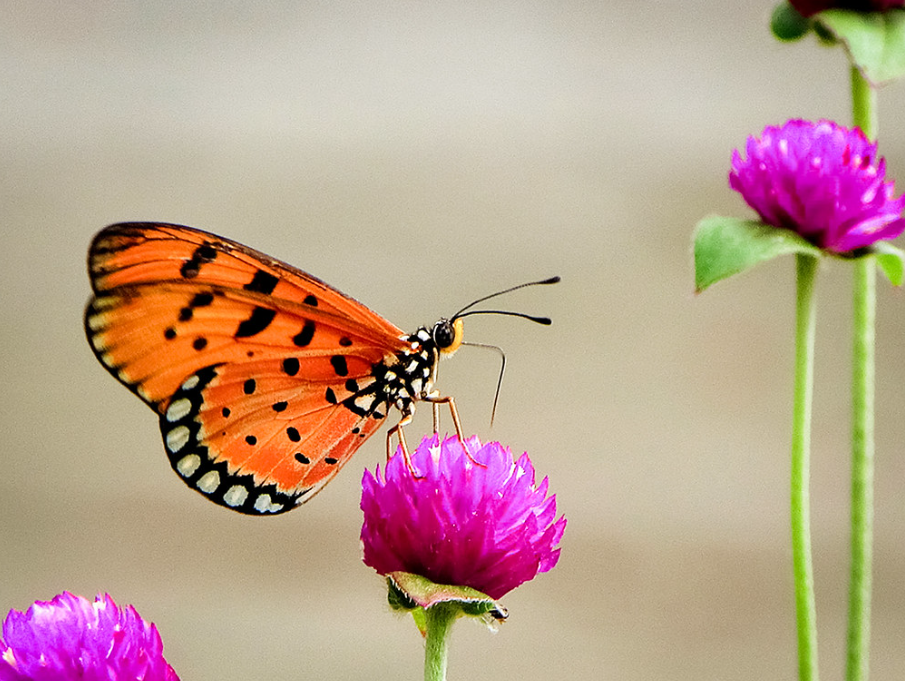
A fast-moving butterfly is helping scientists prove that Facebook and Flickr aren’t just for holiday snaps, they could be key allies in tracking invasive species and monitoring biodiversity shifts in real time.
In a new study published in Conservation Biology, an international team of researchers led by Monash University School of Biological Sciences have shown that social media platforms can provide faster, broader, and often more detailed biodiversity data than traditional sources.
The team, led by Dr Shawan Chowdhury, used public Facebook and Flickr posts to track the tawny coster butterfly (Acraea terpsicore) and uncovered a far more extensive and rapidly changing distribution than existing biodiversity databases revealed, including its spread into Australia.
“Social media gave us faster, broader, and often more precise data than the world’s largest biodiversity repositories,” said Dr Chowdhury.
“We found the tawny coster expanding into higher elevations and latitudes, including right here in Australia. This is real-time evidence of how species are moving as the planet warms, and it shows we need to get smarter and faster in how we track it.”
Native to India, Bangladesh and Sri Lanka, the tawny coster has rapidly expanded its range into other South Asian countries. Since its first Australian record near Darwin in 2012, the butterfly has spread eastward across the Top End and into Queensland, covering over 135 kilometres per year.
While there has been no economic impact in Australia, and the species is not yet a declared pest, it is considered a pest species in Sri Lanka, for example. Its expansion into new ecological zones raises red flags for native ecosystems and long-term biosecurity.
The research team compared global butterfly records from the Global Biodiversity Information Facility (GBIF) with geotagged social media sightings. Integrating both sources led to a 35 per cent increase in total records and significantly improved species distribution models.
These enhanced models revealed two key findings:
- Social media data captured faster and broader range expansions, particularly in regions where formal monitoring was sparse.
- GBIF-only records systematically underrepresented areas with cooler maximum temperatures, lower rainfall, and higher elevations, environments that may be critical for species survival under climate change.
“These additional records filled major gaps, especially in countries underrepresented in biodiversity databases,” said Dr Chowdhury. “It’s a powerful reminder that conservation science can’t afford to ignore citizen observations. Social media isn’t noise, it’s data. And often, it’s the kind we need most.”
Research collaborators include: Professor Aletta Bonn (iDiv – German Centre for Integrative Biodiversity Research); Professor César Capinha (University of Lisbon, Portugal); Professor Phill Cassey (University of Adelaide, Australia); Dr Ricardo Henriques Correia (University of Turku, Finland); Dr Gideon Deme (University of Turku, FInland); Professor Moreno Di Marco (Sapienza University of Rome, Italy); Professor Enrico Di Minin (University of Helsinki, Finland); Dr Ivan Jarić (Université Paris-Saclay, France); Professor Richard Ladle (Federal University of Alagoas, Brazil); Dr Jonathan Lenoir (Université de Picardie Jules Verne, France); Dr Mohammad Momeny (University of Helsinki, Finland); Dr Jooel Rinne (University of Helsinki, Finland); Dr Uri Roll (Ben-Gurion University of the Negev, Israel); and Ripon Roy and Niloy Hawladar (University of Dhaka, Bangladesh).
The research follows a recent research published in Biological Conservation. This study demonstrated that supplementing social media records into existing biodiversity datasets, such as GBIF, can improve our knowledge of invasive species distribution and fill geographic and environmental gaps, especially in biodiverse, under-sampled regions, thereby improving species distribution models and strengthening conservation decision-making.
The latest research supports global biodiversity monitoring under the UN Kunming-Montreal Framework and offers a scalable tool for tracking future species invasions in real time.
FURTHER INFORMATION
Read the research paper: https://doi.org/10.1111/cobi.70234
ASSETS AVAILABLE
Vision and images available here.
MEDIA ENQUIRIES
Hande Cater
Media and Communications Manager
P: +61 456 428 906
E: hande.cater@monash.edu
Silvia Dropulich
Marketing, Media & Communications Manager, Monash Science
T: +61 3 9902 4513
M: +61 435 138 743
Email: silvia.dropulich@monash.edu
GENERAL MEDIA ENQUIRIES
Monash Media
P: +61 3 9903 4840
E: media@monash.edu
For more experts, news, opinion and analysis, visit Monash News.